Begin where rubber meets the surface
Every acceleration, steering and braking request must pass through four small contact patches. Their available grip changes with the road surface, tyre compound, temperature, water and snow. A vehicle that climbed easily out of a parking area may still struggle to stop on polished ice a few kilometres later.
Winter tyre sipes create additional edges, while the tread pattern manages water and loose material. Compound matters too: two tyres with similar-looking grooves can behave differently in cold conditions. Nordic winter designs and winter tyres developed for milder, faster roads serve different compromises. Ask a competent tyre supplier about your actual route rather than choosing only by appearance.
AWD distributes drive, not extra friction
All-wheel drive can use available traction at both axles to help the vehicle move. Some systems operate mechanically; others use electronically controlled couplings or separate electric motors. Their behaviour varies with software, temperature and the available drive modes. None creates grip when the tyres have exhausted it.
Most passenger cars already brake all four wheels. Adding driven wheels therefore does not provide an equivalent improvement in emergency braking. Anti-lock braking and stability control help manage wheel slip and vehicle direction, but both remain constrained by the surface. Avoid treating a flashing traction-control light as permission to apply more power.
| System | Useful capability | Important limitation |
|---|---|---|
| Front-wheel drive | Often predictable with suitable winter tyres. | Uphill acceleration can overload the available front-tyre grip. |
| Rear-wheel drive | Modern traction control can manage power effectively. | Grip depends on load distribution and surface; smooth inputs remain essential. |
| All-wheel drive | Can improve moving off and sustained climbing. | Does not guarantee shorter stops or better cornering. |
A strong launch is a traction demonstration, not a braking test.
Inspect the fitted set, not the invoice
Check all four tyres for damage, uneven wear and adequate tread. Verify that their sizes, load ratings and intended use match the vehicle instructions. Different grip characteristics between axles can make handling less predictable. A spare wheel may also impose speed or distance restrictions, so know what your car actually carries.
For passenger cars up to 3,500 kg, Norwegian winter-period tread requirements generally specify at least 3 mm. The relevant periods differ in Nordland, Troms and Finnmark. Legal tread depth is a minimum, not a promise of safe performance. Drivers must provide sufficient grip for the conditions even outside the calendar periods. Check current guidance from Statens vegvesen before travelling; heavier vehicles have different requirements.
Check pressures when the tyres are cold, using the vehicle's recommendation for the actual load. Do not deliberately reduce pressure for normal public-road winter driving unless the manufacturer gives a specific procedure. A warning system does not replace a gauge, and a pressure change after a temperature drop should be investigated rather than ignored.
Studs and chains need a route-specific decision
Studded tyres can offer benefits on ice, but they involve noise, road wear, seasonal restrictions and possible local charges. Studless winter tyres avoid some of those complications but still require an appropriate design and careful driving. There is no single tyre choice that makes every Norwegian winter surface straightforward.
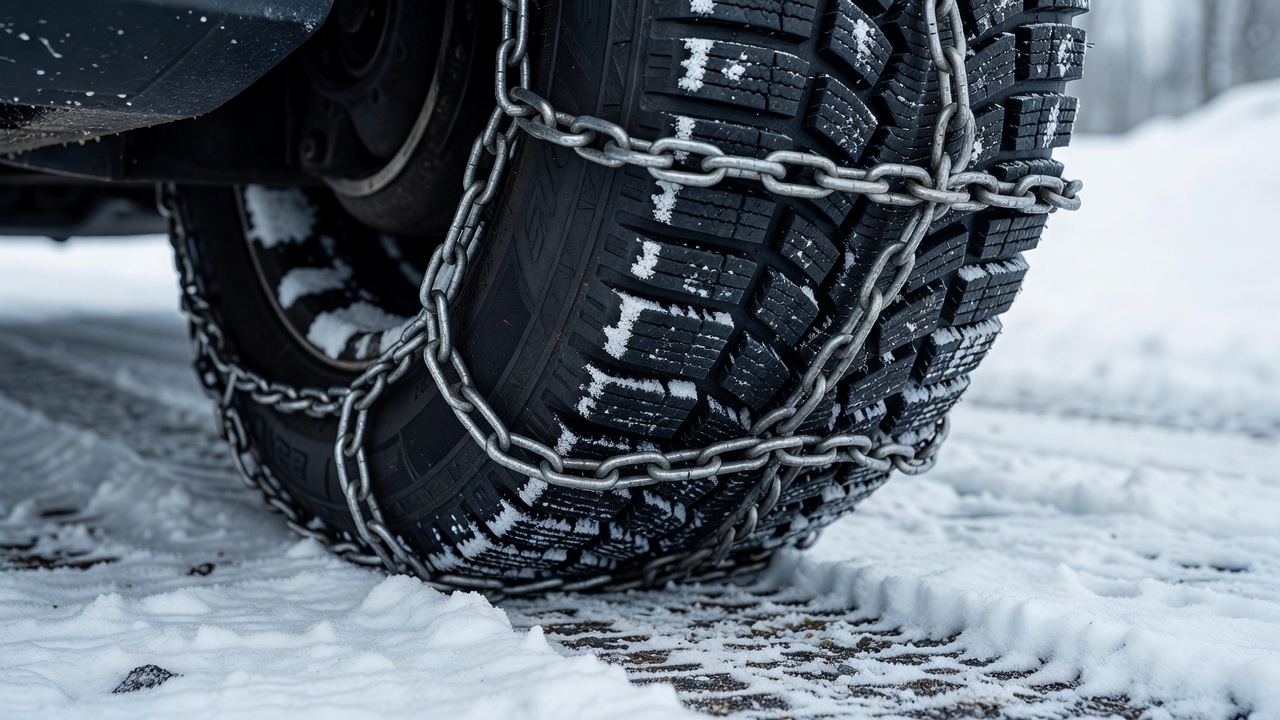
Chains are not universally suitable for every wheel and tyre combination. Large wheels, suspension clearance and manufacturer restrictions can rule out some products. Confirm the correct axle and fitting method in the handbook, carry gloves and a kneeling mat, and stop in a safe location before conditions make fitting difficult. Never continue at ordinary road speed on chains.
Choose a vehicle you can manage
For routes around Geilo, Dovrefjell or Hemsedal, ground clearance can be useful in loose snow, but it does not justify entering an unploughed or closed road. A heavier SUV carries more momentum; a compact car on good tyres may be easier to place on a narrow road. Consider visibility, controllability and suitable tyre availability alongside clearance and drivetrain.
At departure, decide whether your fitted equipment suits the forecast and the route. If the answer depends on everything going perfectly, choose a different road, delay the trip or improve the equipment. Driver judgement is the final part of the grip system.